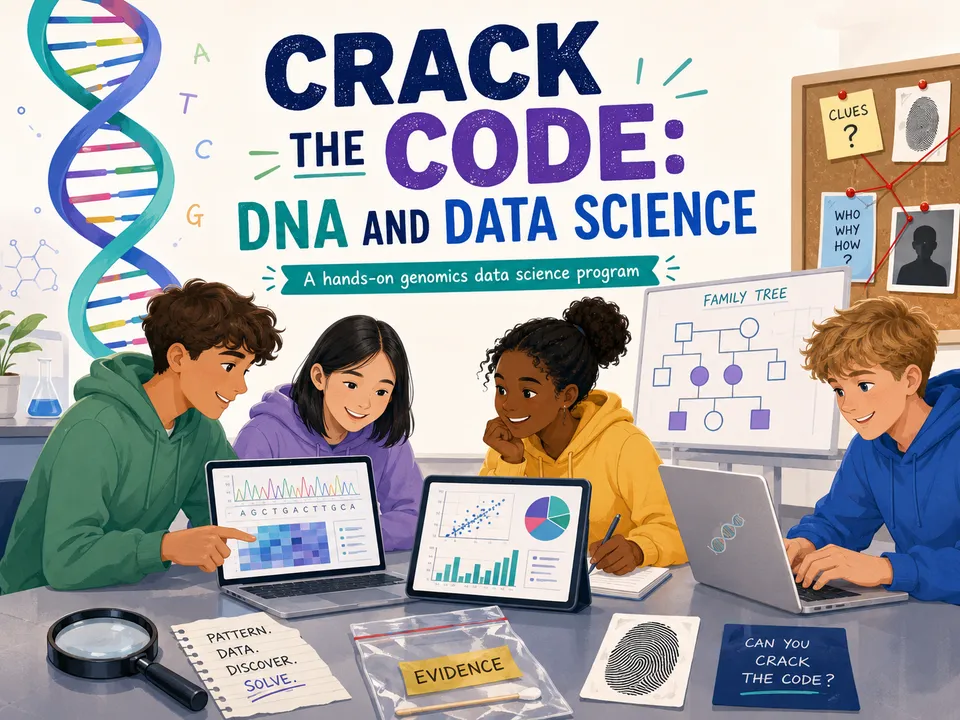
Crack the Code: DNA and Data Science
Crack the Code: DNA and Data Science
A hands-on genomics data science program for high school students.
Event Overview
In this three-week, hands-on program, high school students will explore how data science can be used to uncover the secrets hidden in DNA. Along the way, they’ll learn Python, work with real-world genomics-inspired data, create visualizations, and discover how scientists use data to study traits, ancestry, inheritance, and biological patterns.
Students will also investigate important questions about privacy, bias, fairness, and the responsible use of genetic information.
In the final week, the lab will be transformed into a forensic escape room and simulated crime scene. Working in teams, students will collect evidence, analyze artifacts, follow DNA clues, examine family trees, and use probability and data analysis to solve the mystery. They’ll put their new skills to the test as they race to interpret the evidence and crack the case!
Program Dates
July 20-August 7, 2026
Mondays, Wednesdays, and Fridays
Weekly Schedule
Class: 1:00-3:00 PM
Hybrid Office Hours: 3:00-4:00 PM
Students should arrive by 1:00 PM. Regular pickup is at 3:00 PM, or anytime between 3:00 and 4:00 PM for students participating in office hours.
Program Details
- Location: HDSI Lab 3.0, UC San Diego
- Audience: High school students
- Cost: $50
- Total instructional hours: 18
- Format: Summer program
Program Expectations
No prior coding experience is necessary. However, students should expect homework assignments throughout the program.
Participants must:
- Commit to attending all nine class sessions—six hours on campus each week
- Arrive on time and prepared to participate
- Complete assigned homework before each class
- Bring a laptop and charger to every session
- Work collaboratively during activities and the final forensic challenge
Activities
Session 1: Introduction to Data Science and Genomics
Students will learn what data science and genomics are, explore how they connect, and begin using Python to work with simple DNA-related data.
Session 2: Working with Genomics Data
Students will learn how to organize, filter, sort, and analyze genomics-inspired datasets using Python lists, tables, and dataframes.
Session 3: Data Visualization and Exploration
Students will create charts and graphs to identify patterns in DNA, genetic traits, allele frequencies, and other biological data.
Session 4: Privacy and Ethics in Genomics
Students will explore why genetic data is sensitive and discuss consent, ownership, privacy, and the responsible use of DNA information.
Session 5: Bias and Fairness in Data
Students will examine how missing or unbalanced data can lead to inaccurate or unfair conclusions, especially in genomics and healthcare.
Session 6: Explainability and Misleading Patterns
Students will learn how graphs, statistics, and models can be misleading and practice communicating data findings clearly and responsibly.
Session 7: Forensic Mystery—Collecting the Clues
The lab will become a simulated crime scene. Students will work in teams to collect evidence, examine DNA clues, and begin narrowing down possible matches.
Session 8: Inheritance and Family Trees
Students will use pedigrees, genetic inheritance, probability, and additional evidence to determine which individuals are most likely connected to the mystery sample.
Session 9: Crack the Case
Students will complete their analysis, solve the forensic mystery, and present their conclusions while explaining the evidence, uncertainty, and ethical considerations involved.
Registration
Space is limited. Please register using the form below: